
Cardinals
about the artist
From a small, dark room on the northside of Cork city – a rehearsal space that is "very cold in the winter and very hot in the summer" – Cardinals have emerged with a debut album that appropriately swings from one extreme to the other. Darkness to light. Light to darkness. Hopefulness to despair. Compassion to chaotic indifference.
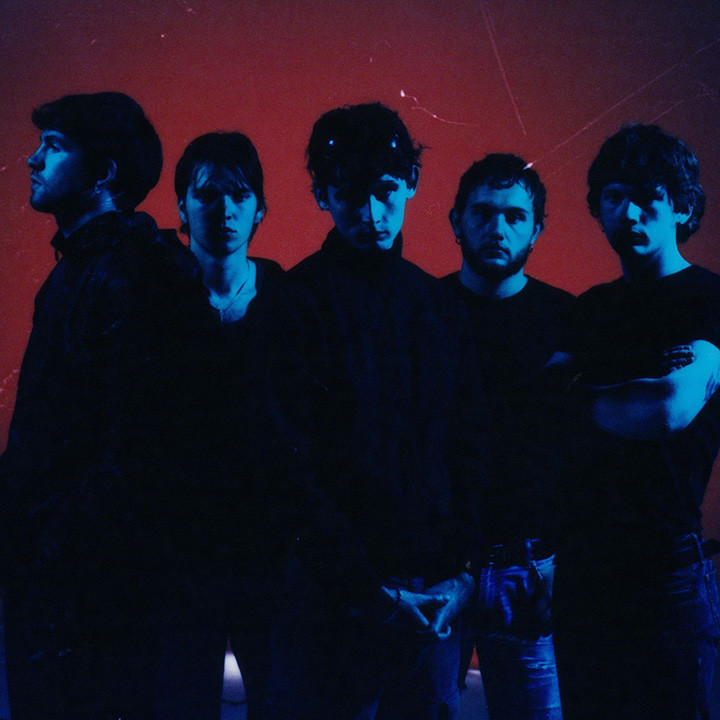
A band forged through both family and friendship – brothers Euan (vocals, guitar) and Finn (accordion) Manning, their cousin Darragh (drums, tambourine, glockenspiel) and their former schoolmates Oskar Gudinovic (guitar) and Aaron Hurley (bass) – the five-piece have already positioned themselves at…
MoreFrom a small, dark room on the northside of Cork city – a rehearsal space that is "very cold in the winter and very hot in the summer" – Cardinals have emerged with a debut album that appropriately swings from one extreme to the other. Darkness to light. Light to darkness. Hopefulness to despair. Compassion to chaotic indifference.
A band forged through both family and friendship – brothers Euan (vocals, guitar) and Finn (accordion) Manning, their cousin Darragh (drums, tambourine, glockenspiel) and their former schoolmates Oskar Gudinovic (guitar) and Aaron Hurley (bass) – the five-piece have already positioned themselves at the vanguard of the Irish independent rock scene. And with Masquerade, they have flung off the shackles of their early influences to craft something entirely their own.
"This feels like a natural progression," says frontman Euan. "The early years feel like a band still finding ourselves and trying different things. Whereas the album's a bit more cohesive and a little bit more sure of itself."
Euan's description of these songs as "soft ballads whipped into urgency out of a panicked necessity" aptly captures Masquerade's mood; these are emotionally expansive songs, some simmering with an undercurrent of violence, cynicism or fervent discontent (Anhedonia, The Burning of Cork, Barbed Wire) others gleaming with a bright-eyed vulnerability. Crafting a record with an A-side and a B-side is a nod to the band's collective love of vinyl, and Masquerade's tonal shift takes its cue from a variety of contrasting influences – from Townes Van Zandt's "soft and beautiful melodies" to heavier fare like Nine Inch Nails, Danish punks Iceage and goth-metal icons Type O Negative, as well as their previously-noted love of hip-hop.
"For the most part, the B-side is a darker and grittier exploration of the themes than what comes before," explains Euan. "I always appreciated it when a record could have that juxtaposition. Bowie's Low comes to mind; to have Warszawa on the same record as Be My Wife is brilliant. Sometimes an artist might be made to feel like they should write something that works and then reproduce it as many times as they can for the record, but exploring and experiencing different states of emotion is a human thing. That's something that interested us when it came to making this record."
Recording the album without a click track proved crucial to capturing the "beautifully imperfect" sound of Masquerade. With most songs written over the past 18 months, the band recorded in the legendary RAK Studios in London, with their fellow twentysomething producer Shrink at the helm. Studio engineer Isabel Gracefield suggested that Euan record his vocals for As I Breathe in the studio's stairwell, which further stripped back the singer's defences.
"Office workers in RAK would descend the stairs after their day's work and I'd greet them with a full mic setup," he recalls, smiling. "It was a jarring experience, at first. Feeling scrutinised by the band or producer is usually enough to throw me off, so with strangers it was a whole other experience. But eventually you just let go and fight through it. And the end result is a take we were very happy with." He nods. "Its vulnerability occurred in real time, as the song was laid down."
When it comes to lyrics, Euan is conscious of leaving songs open to the listener's interpretation. He rails against the idea of songs having to be borne from personal experience, describing it as 'reductive' to assume that songwriters cannot write from a place of fiction or imagination, like any other writer. "I wish that my life was as interesting or as romantic as some of the songs make it out to be," he laughs. "But a lot of them are just stories."
One real world element that did unintentionally become a running theme on the album was the multitude of religious references littered throughout Euan's lyric sheet, whether it's "Bask in the relief/ At the throne of Jesus Christ" on She Makes Me Real, "Don't you think I'm holy? / The way the cross is on my neck" on Over at Last, or As I Breathe's "You can wear the chain, I'll wear the collar of my clerical order."
"We all probably have different ideas individually of what our faith might be – but I think we're all really interested in the beauty of churches and religious symbolism, and stained glass," says Finn. "I do think we all have some form of faith on the spectrum somewhere. I think the shift from a seriously Catholic country to a fairly secular country after the Murphy Report in 2009 probably had an effect, as well. Big social changes that happen when you're a child do affect you more than you realise."
Euan nods. "I try not to look too closely at what it is or why it appears so much in my songwriting," he shrugs, "but it's there, and we're definitely connected to it – whether we like it or not."
There are other subtle nods to real life, whether drawn from personal experience or not. Cardinals rebuff the notion of being branded as a "Cork band" or even an 'Irish band," shirking off the 'fetishisation' of Irish culture that is being brazenly embraced by other acts and embellished by certain factions of the media. Nevertheless, their adopted city is in their creative DNA. The ferocious jolt of Anhedonia was inspired by a violent incident that Euan witnessed not long after moving to the city from the band's hometown of Kinsale. Barbed Wire, with its lyric "Alcohol and ecstasy / And Aperol and THC / From City Hall / To George's Quay" was partly inspired by the acclaimed Irish writer Kevin Barry's work, notably an essay that he wrote about his time in Cork. The Burning of Cork is an inadvertent protest song of-sorts, which draws parallels between the ongoing genocide in Gaza and the British forces' decimation of Cork in 1920, as the lyrics despair at the patterns of violence repeated "again and again and again."
Other external touchpoints include the band's discovery of the work of Norwegian-Irish artist Oda Sønderland. Her painting Fristeren was formative in creating the world of the record and shaping its themes, and which now graces the cover of Masquerade.
"It's such a striking image: it's like a refuge in what is otherwise a harsh and cold environment," says Euan. "When I think of listening to records, or watching movies or art in any way, that's the way that I see it; as this place of refuge and intimacy. I think we all fell in love with that piece. It's completely beautiful. And I think we just kind of knew that it had to be the cover."
It's clear that Masquerade marks a new era for Cardinals. The making of the album has revealed something new of themselves, opening them up as a more collaborative entity – as evidenced by closing track As I Breathe, written just one week before they entered the studio. While much of the record's lyrical content deals with the trials and complexities of navigating life, the album ends on a tentatively hopeful note with the striking line "Even as we fall / I have learned the world is small / And I proceed."
"I think you can definitely put the emphasis on 'band' now more than ever, for the five of us as a working unit," nods Euan. "The first album is daunting, but I feel like you're not going to look at anything the same afterwards, artistically. The work that goes into it is an awful lot, and you're putting a lot on the line in terms of vulnerability and opening ourselves up, emotionally." He sighs softly, smiling. "It'll change whatever we decide to do next, musically or otherwise. I think it'll have that effect on all of us."